


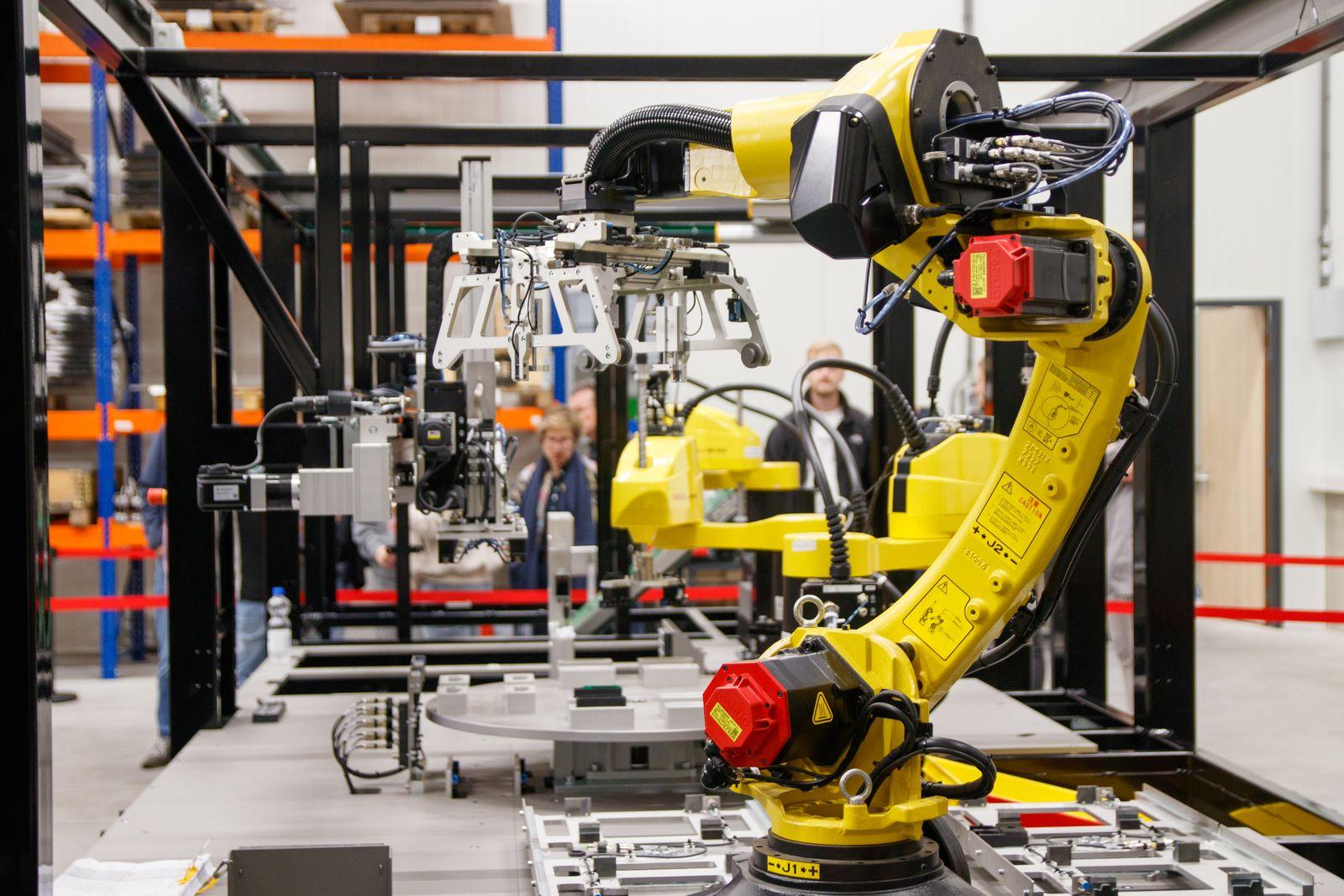
A robotic arm is a jointed machine that moves a tool through a programmed path. Welders, palletisers, machine-tending cells and packing lines all use one, but an arm built to swing a welding torch around a car body is a poor fit for placing chips on a circuit board.
This guide covers:
- The four arm layouts you will actually see for sale
- How payload, reach and repeatability limit the work
- What to inspect on a used arm before you buy
- Where each type earns its place in a factory
What the arm is made of
Every arm is a chain of links and motorised joints, ending in a tool. The joints are the axes. A six-axis arm can tilt and rotate a tool the way a human arm and wrist can. A four-axis arm is faster and stiffer, and it gives up some of that freedom.
The parts that matter when you buy
- The manipulator is the arm itself. Condition of the joints, cables and casting is what you are paying for.
- The controller is the cabinet that runs the motion. An arm without a matching controller is a project, not a working robot.
- The teach pendant is how an operator jogs the arm and edits points. Ask whether it is included.
- The end effector is the gripper, torch or screwdriver on the wrist. It is often sold separately, and it has to match the part.
Four layouts, four jobs
Names vary by brand. The geometry does not. If you can see how the arm folds, you already know most of what it can do.
Articulated
Rotary joints in series, usually six axes. This is the yellow arm over a weld cell or a machine tool. It reaches around obstacles, mounts on the floor, wall or ceiling, and handles welding, tending, palletising and painting. It is the most common used industrial robot, and the most flexible. It is also the one that needs the most floor space and the most careful path programming.
SCARA
Selective Compliance Assembly Robot Arm. Two rotary joints in the horizontal plane, plus a vertical quill for the tool. SCARA arms are fast and rigid up and down, which makes them the default for screwdriving, pick-and-place and light assembly on a bench. They do not reach over tall fixtures the way a six-axis arm does.
Delta
Three arms hang from a frame above the work and meet at a small tool plate. Deltas are built for speed on light parts: packing biscuits, sorting parcels, placing toppings. Payload is small, often a kilogram or two, and the work stays under the robot.
Cartesian
Linear axes at right angles, like a gantry or a plotter. Motion is simple to picture and easy to guard. Cartesian robots show up on pick-and-place gantries, 3D printers, dispensing cells and large work envelopes where a jointed arm would be awkward. They are less common on the used market as a branded “robot,” and more often sold as a cell.
| Layout | Typical axes | Best at | Weak at |
|---|---|---|---|
| Articulated | 6 | Reaching around a part, welding, tending | Very fast light packing |
| SCARA | 4 | Bench assembly, screwdriving | Tilting the tool at odd angles |
| Delta | 3 or 4 | High-speed picking from above | Heavy parts, side reach |
| Cartesian | 3 or more | Long, straight, guarded travel | Compact cells, curved paths |
The three numbers that decide the fit
Brochures list dozens of figures. Three of them decide whether the arm can do the job.
- Payload is the weight at the wrist, including the gripper, not just the part. A 10 kg arm with a 4 kg gripper has 6 kg left for the product. Add a safety margin. Running at the limit every cycle wears the brakes and the gears.
- Reach is how far the wrist can extend. Measure the real cell, including the stand height. A long reach with a light payload is a different machine from a short, strong arm.
- Repeatability is how closely the arm returns to the same point. Assembly and dispensing care about tenths of a millimetre. Palletising usually does not. Repeatability is not accuracy: an arm can be consistent and still need its points taught in place.
Buying a used arm
Most arms on the second-hand market came out of a cell that was rebuilt or closed. The arm can be excellent. The paperwork and the matching parts are what go missing.
Ask for these before you commit
- Controller, teach pendant, and cables as a set. A bare manipulator is hard to power up and harder to value.
- Hours or a servo-on time, and whether the brakes and batteries have been serviced. A dead encoder battery can wipe mastering.
- Photos of the wrist, the cable dress pack, and the base connector. Crushed dress packs and oil at the joints are the usual wear.
- The software options that were licensed. Welding, collision detection and conveyor tracking are not always on the cabinet you receive.
- How it was taken out of service. A crash shows up as a bent casting or a wrist that will not master. A clean decommission is a different risk.
Brands you will see most often are FANUC, ABB, KUKA and Yaskawa for articulated arms, and Epson, Yamaha, Fanuc and Stäubli for SCARA. Deltas are fewer, and they are often sold with the frame they hang from. Match the model to the payload and reach you measured, then confirm the controller generation. A newer pendant will not always talk to an older cabinet.
Questions people ask
Is a cobot a different kind of arm?
Usually it is still an articulated arm, built to run closer to people, with force limiting and a rounded shell. The layout is the same. The safety case is not. A cobot does not remove the need to risk-assess the gripper and the part.
Can I use any gripper?
The wrist has a bolt pattern and a weight budget. Pneumatic grippers need air at the arm. Electric ones need a cable through the dress pack. Check both before you assume a gripper from another cell will fit.
Why do two arms with the same reach cost so differently?
Payload, repeatability, the controller generation, and whether the pendant and cables are in the price. A complete, recently serviced six-axis arm is worth more than a higher-payload arm sold as a bare casting.
Related
Looking for an arm?
Browse industrial, SCARA, delta and collaborative arms from sellers on Robotbids.